Showing posts with label international swing. Show all posts

Thursday, 27 February 2025

Trinity Swing 2025

It’s hard not to start my first article in five years without some way acknowledging the fact that it's my first article in five years. As a bespectacled leather-clad dino-dodging chaotician once said, "Life… uh… finds a way" and sometimes that's just to get in your way. And at various stages over the last few years the way to dancing has been Gandalfed by this, that or the other.

But then something comes along that makes it impossible not to scratch that itch and start typing. And that thing was Trinity Swing 2025.

I’ve still being going to events here and there—last year I had a “treat yo’self” moment for one of those birthdays ending in zero and I nipped over to the USA for what had long been the event atop my bucket list: the West Coast Swing/Lindy Hop lovechild that is the Boston Tea Party. It was all I'd hoped for: Lindy classes, Westie classes, fab socials for both, meeting great people, catching up with old friends (including an unexpected birthday celebration), and getting to saunter around one of my favourite cities in the US… it was a brilliant weekend but I still didn’t feel like composing an article (maybe I still will).

But as great as it is to be a visitor in a foreign land, it’s an entirely different experience to be part of the local community hosting an event and to feel the joyful energy and appreciation from 'outsiders' who have invested faith, time and money in what your community can offer. Then, when all's said and done, to feel your heart explode with love and pride at what your community can achieve.

First, a quick disclaimer: I had nothing to do with organising this event. I was as much a guest as the next guy, so I get to say everything here from a point of relative* objectivity (*I say relative… there’s every chance some biases may creep in…) and I’ve no credit to claim. Secondly: I missed Friday and most of Saturday due to the aforementioned reasons, but still I got more than my fill.

Photo of the event on Friday night at Trinity Swing 2025Friday night at Trinity Swing. Pixploration©

I arrived on Saturday just in time to catch the last few songs of the ‘Shindig’ live acoustic set by Peter Kennedy. Truth be told, I’m not normally a fan of live music at dance events. There are musicians who perform for listening and there are musicians who perform for dancing, and more often than not the former turns up where the latter was hoped for. This can most dangerously manifest itself at Lindy hop events where, goodness knows why, the incredibly gifted band performing thinks that a 12-minute high-tempo barnburner is as much fun to dance to as it is to listen to and your smart watch is trying to draw your attention to the alarming altitude of your heart rate. Or where a musician plays about with the volume and does such a long and convincing diminuendo that you believe the tune has finished; so you thank your partner, walk off the floor, and find someone else for the next dance only to discover, as the volume picks back up, that it’s actually the very same tune and your previous partner is standing exactly where you left them reeling from your infidelity. 

But Peter was just fantastic—great to listen to and great to dance to—and there was an extra treat for those of us who went into Carlingford on Sunday night where he gifted us a bonus set including a few more cracker medleys. But more on that later.

Then it was time for the pro-shows which are always a highlight, but when one of the pros is Gráinne Farrell—one of ours—it’s a new combination of feelings because as well as excitement, appreciation and wonder there’s also pride involved. And all the while being performed in front of an enormous ‘Trinity Swing’ event banner. 

And the banner matters because it communicates that you're not at just another local social but at something much bigger. It communicates to everyone—there and watching online after—that “we’re legit,” that there’s something going on here that you want to be a part of. A big naff off banner to celebrate the fact we're now a big naff off thing. 

But a good banner without good dancing would be 'all fur coat and no knickers' so I'm very proud to say Trinity Swing was clearly quite tastefully undergirded.

As already mentioned, I missed Friday in its entirety as well as the classes and competitions on Saturday, so I arrived as a relative stranger to many, not having had the opportunity to meet folk in class or on the dance-floor the night before. But I was up to speed in no time at all because the vibe was so infectiously positive.

To be clear, I can’t say I’ve ever experienced a negative vibe at a dance event but this one just felt extra positive. Maybe it’s because I already knew a reasonable number of people there, or because I arrived in the middle of the weekend so the first night pre-competition jitters had already been dispensed with, but I didn’t feel like I needed to warm up at all (despite not having danced WCS for 5 months). And add in the discovery that one of my absolute favourite dancers was at the event (I wasn’t counting but I’m convinced I set a new PB for most dances with one person in a single weekend—thanks, Ji) and things were shaping up to be rather decent.

Plus: I can’t actually remember having a single bad dance. My dance partners from the weekend may not agree, I’m not going to pretend every dance I shared was pure gold, and there were a few where I thought I definitely could have done better. But I didn’t have one single yup-I'm-done-with-this moment all weekend; which is a bit of a rarity to be honest.

And I really think that was down to the positive feeling that permeated the whole weekend: it was the craic! Missteps and dropped connections were quickly forgotten and I’m not sure if I’ve ever shared so many back-to-back “can we have another dance?” moments at a single event. Which set things up really nicely for the wee small hours.

Normally by the end of the night, I hit a point where I realise I’ve danced with just about everyone left in the room at least once. A quick scan also involves trying to remember how recently we just danced, how did it go, did I think they enjoyed it, and do I think they'd be receptive to me asking again. There is also the mild panic that comes from thinking "but now they know all my moves!" and worrying I might bore my partner when I repeat all the same stuff.

But both nights I confidently approached, or was approached by, just about everyone for multiple dances, such was the relaxed feeling on the floor. It was so refreshing and clearly it was not just me having the time of it.

As for the actual end of the night, however, I had a slight oversight by not actually planning the logistics correctly. 

With it being a 'home' event, I thought I'd save a bit of cash and just drive home once the dancing was over (I'm averse to premature evacuation) but by that stage of the morning a 90-minute drive simply wasn't appealing. Or, for that matter, terribly wise. Thankfully, Sarah had encouraged me to throw together an overnight bag before I left the house just in case I was overcome with sense. But even more thankfully, as I started to walk towards the hotel reception in the hope of being told they'd a spare room, I was offered the spare bed in the room of two other Belfast locals on tour, so thanks again to Miles and Richard!

Due to my late arrival the night before, Sunday was the only day I got to attend classes which meant I unfortunately missed Lee and Fab entirely but I was still able to get along to three of the four other teachers/pairs. First up was Gráinne Farrell (yeeooo!*) and Mathieu Compagnon with a smooth pattern I'll definitely be incorporating into my vocabulary, followed by my first 'switch' workshop with Rosemary Whitson that showed me just how much I need to work on my following. But I then made a slightly bold call and went to Sean and Alyssa McKeever's class rather than staying put for James Bartlett and Lauren Jones.

(* admittedly a guttural "yeeooo!" isn't quite as elegant as the French encouraging each other at events with an "allééé!" but the sentiment is similar in Northern Ireland at least)

The Banner and the ProsSharon, the pros & the banner. Pixploration©

I'm sad I missed James and Lauren, and I did get to ask Lauren for a dance later (fantastic, obviously), but Sean and Alyssa were the headliners, have been high high high up my list of pros I've wanted to take a class with for years, and this was my only chance to do that. So, although it was a more advanced level than I was otherwise signed up for, I figured I would go in and at least observe. And if I felt I wouldn't be a hindrance I would ask if I could join. 

So much for being inconspicuous.

Because it wasn't a regular everyone-dance-together kinda class. Rather the entire group was asked to sit, then Sean and Alyssa offered their critique as, one-by-one, couples got up and did a mini-spotlight.

And the opportunity for me to dissolve into the wallpaper rapidly disappeared when I was asked to lead two different follows.

I'd attended a class like this the year before in Boston with Arjay Centeno, although that time I didn't actually take the opportunity to get up and instead sat anonymously in the corner. I remember regretting missing out on what was effectively a mini-private, and that had been with a larger group of dancers I felt much more on par with, and with several couples getting up at once. So whilst I was keen to actually make the most of the opportunity this time, it was also very much swaddled in apprehension.

But what a class.

My bit went fine and I can take solace from the fact I didn't embarrass myself, but the critique from Sean was something I would expect to pay big bucks for. Plus, I was able to observe all of the other leads, listen to the feedback they received, and in doing so identify things I also need to work on myself. I hope no one thought I was being rude or disinterested but I frantically typed notes on my phone throughout the class and if I can use even half of them to improve my dancing I know it will make a big difference. Seemingly my gamble paid off.

That was the final class of the weekend but one of the highlights was about to kick off after a brief social break: the Newcomer Competition.

One of the focuses of the event was the "Zero to Hero" track, coordinated by Vicky Vasiliauskaite, which invites anyone with absolutely no previous WCS experience to learn the basics over the course of the weekend and then, if they feel up to it, to compete in front of the entire event's audience.

Zero-to-Hero finalists enjoying the momentZero-to-Hero finalists enjoying the moment. Pixploration©

I'd seen Vicky's brilliant concept in action last year at the Midland Swing Open and it was repeated here with similarly immense success: a dance-floor filled with newcomers, looking like they belonged, looking like they felt they belonged, and a euphoric crowd cheering them on. It was hard not to be moved by the amount of love and support in the room and to me this is what dancing is about. I've already commented on the atmosphere of the event as a whole but it was here that it really fizzed, and that pride feeling started to surface all over again.

Then it was off to the pub for something to eat, drink and, maybe, a bit of live music. And as numerous people said to me after: this was the outing that truly gave Trinity Swing its unique identity.

To start off, Carlingford is a beautiful village that sits at the foot of Slieve Foy ('slieve' is the anglicisation [and phonetic spelling] of 'sliabh' or 'mountain') and at the head of Carlingford Lough, and plenty of its streets and signage still retain the original charm that make it such a popular destination for those seeking "authentic" Ireland. The Carlingford Arms did a masterful job of accommodating the 40-odd people who rocked up at their door for dinner without fair warning (noted for next year) and after squeezing us all into their restaurant, we were soon all subsequently tempted into their adjacent (and smaller) pub by the sound of live music.

The original plan had been to give everyone about an hour, maybe an hour and half, to grab a pint of the black stuff and listen to the musician-in-residence, but it was soon plainly apparent that no one was in any rush to get back, and I'm sure the fella behind the bar hasn't worked as hard on a sports-free Sunday night in a while.

Whilst there was no dance floor per se, and space was at a premium (even without the 40 of us) it didn't stop the evening turning into a frantically happy social with people giving it stacks no matter what was playing. And as most of us aren't dance-monogamous it meant, with the right tune, different styles came out to play and were soon copied or cheered by the rest. We had jam circles, country line-dancing, salsa, Lindy hop, Charleston, I'm fairly certain I saw the Macarena at once stage, and we definitely had a conga going that, due to the tight conditions, put me in mind of the last stages of 'Snake' on the old Nokia phones (there's a reference that has gone over the head of plenty).

By this stage, the guy playing was in need of a well-earned break but before he put down his guitar up stepped Peter Kennedy to volunteer to take over for a while. These two swapped over several more times as the night went on to ensure no one was deprived of phenomenal live music covering every genre under the sun, including a smattering of Irish traditional to ensure that when our tourists did eventually head back to the main event to join another fantastic final night social, they did so with that particular bucket list item well and truly ticked.

In case it wasn't evident, I loved this event. And I missed half of it! But that in itself says something.

I go to events in different places to experience different countries, cities and cultures but most of all I go for the people and the atmosphere they create. So often I choose events because I've met dancers from that event's local scene who—through their fun and warmth (and I suppose their dancing)—make me want to visit. Then off I trot and discover that those few I met somewhere else really were true ambassadors for their home scene.

Ireland as a whole may not be able to boast too many roving ambassadors just yet (though the number of new Belfast and Dublin dancers on the weekend's Zero to Hero track makes me think things are on an upward trajectory!) but I've been so encouraged by what I've heard from those who made the trip here. It sounds like they really felt welcome and that they'd the kind of experience I look for when I travel for events, so it's hard not to feel a little proud of that. Add in the fact that, courtesy of this year's successes, Trinity Swing is now officially a WSDC event and the pride keeps coming.

But before I finish I must also give particular mention to Sharon Matchett. Sharon was the weekend's fabulous MC, event organiser, event director, artistic director, location scout, tour operator, chief negotiator, head chauffeur, and has been the force pushing WCS in Ireland forward. There are others who have helped and continue to help, and Sharon would be the first to ensure others know they are appreciated (as demonstrated by her emotional closing compèring on Sunday evening), but otherwise the stonking success of Trinity Swing was simply down to Sharon willing it into being. For most of us in Belfast, she's the reason we got into WCS and now she's the reason people from across the world are coming to Ireland to experience WCS here. Safe to say, everyone who enjoyed Trinity Swing has a lot to thank her for.

See you all next year at Trinity Swing 2026 (6th-8th February).

Monday, 4 November 2019

Event Report: Oslo Lindy Exchange 2019


Four years ago I went to OLX and had a brilliant weekend in a beautiful city with wonderful dancers and people, and I can happily share that OLX 2019 did not disappoint on any of those fronts.

The difference, however, was that whilst my 2015 OLX trip took me to Oxford, for OLX 2019 I went to Oslo!

But unlike a few unfortunate supporters of my beloved Liverpool FC, who recently confused the Belgian cities of Genk and Gent, I arrived precisely where I meant to. And paraphrasing Gandalf also provides a convenient segue to the weekend’s first social venue: Moria!

I’ve learnt that (Soria) Moria is the name of Norway’s most cherished mythical castle, and it can be found on a variety of buildings around Oslo, but seeing it in neon atop an impressive portico excited the Tolkien fan within.

And so, once my opinion of Norwegian cuisine had recovered from the shock of finding "kitten in coconut milk" on a local restaurant menu (Google mistranslated the word 'kylling' - chicken), it was time to head into Soria Moria for the first social of the weekend.

some of the famous sculptures in Frogner Park looked familiar...


Friday’s venue, which also hosted Saturday night’s social, was a brilliant setting with a great floor, ample space for the excellent live acts, and plenty of room if you wanted to catch a breather and chat with some of the other dancers.

And the live acts truly were excellent.

On Friday we had the Birkelunden Big Band, while on Saturday the Jazzombies and the Shoeshine Boys traded short sets for a few hours, and I cannot tell you how jealous I was of this amazing music line up. As well as the talented instrumentalists and charismatic band leaders there were also some immensely gifted vocalists channelling Ella Fitzgerald and Billie Holiday for another layer of halcyon charm. Credit must also go to the DJs who ensured that the weekend’s stellar soundtrack continued throughout.

Also, at sign-up on Friday, everyone was offered the opportunity to join the weekend’s ‘amateur band’ who performed at Sunday’s farewell tea dance in Bygdelagssamskipnaden (non-Scandis can rejoice that it is just referred to as ‘BLS’), and considering the very brief amount of rehearsal time squeezed in over the weekend, they too put on a cracking performance.

One of the highlights of any exchange is the opportunity to stay with a generous local host (especially considering the expense of a Nordic city like Oslo), and on this front I definitely lucked out as Erik proved to be a top host and a top bloke.

Although work commitments kept him from getting to Friday’s social, Erik made sure that the directions and keys to his apartment made their way to me (thanks, Liv Julie!) – and that in and of itself is another example of why I love the Lindy hop community: I’d never previously met Erik and knew very few people in the Oslo scene, but yet I was still entrusted with the keys to his home without question.

Add in the fact that he cooked me a fry each morning and you can see why we got on, plus: a special mention must be made of Erik’s home-baked bread. Oh yes indeed.

On Saturday, we met in Kulturhuset, a quirky bar and cultural hub to begin a jazzy tour of Oslo which saw us split into teams and take off around the city, following clues to various locations where we were to perform a variety of jazz steps. Aside from the frankly horrendous weather, it was great craic and a great opportunity to chat away with other dancers whilst getting to know the host city a little better before another great night of dancing in Soria Moria.


Sunday’s social activity was a uniquely Nordic affair as we all headed to SALT - a “nomadic art project… that brings together art, music, food and architecture”… and saunas! Now, truth be told, I am not a sauna fan, but I just did not want to miss out, and considering the setting on Oslofjord faced the iconic Opera House, and the weather finally decided to play nice, I was very glad I went.

As well as having your choice of sauna, depending on whether you wanted to be steam boiled, medium-cooked, or just lightly blanched, there was also a traditional Sámi sauna ritual which, despite my struggles (whilst everyone else sat serenely on the top benches, I was practically lying on the floor trying to get cool and adamantly refusing to be the first to quit) I actually enjoyed. Getting repeatedly hit with a cold water-soaked bush was an unexpected highlight, and the additional opportunity to dash out of the sauna and jump into the ball-shrinkingly cold fjord was an exhilarating one.

SALT also had a number of food huts and a suitable space for dancing, plus the saunas themselves are a famously social activity, and I must thank everyone for very kindly speaking in English as much as they did. Despite nearly everybody else being Norwegian or Swedish and therefore very capable of conversing in a homely tongue, they more often than not switched to English to ensure I wasn’t left out. Thank you!

The farewell tea dance was a relaxed affair and featured cake (result!) but as I was staying for longer than just the weekend I thankfully didn’t have to say farewell to Norway just yet!

Additional bit of background info: I have wanted to visit Norway since I did a school project on Vikings and the fjords when I was eight (which my mum remarkably still has), and above all else I have wanted to see the fully preserved 9th century Oseberg ship. I was rather excited.

the Oseberg ship!
not vertigo friendly
I was also very lucky to have had a local tour-guide for the day so I must say a huge thank you to Hildegunn for offering to show me around (and translating)! After visiting the Viking Ship Museum, the Museum of Cultural History and the beautiful Huk park on Bygdøy, we then went up to the 1952 Winter Olympic venue of Holmenkollbakken, where we may or may not have disregarded a series of barriers and stern looking warnings to climb to the very top of the famous ski jump via a fairly precarious stairway (above) for a spectacular view of Oslo (below).

a stunning view of a stunning city [side note: ski jumpers aren't wise in the head]


On the Monday night I went for a solo saunter around the city and then (sorry Erik) decided to try out the electric scooters that I had seen scattered about the city; also doing my very best to avoid scattering myself across the tarmac.

In the day or two I used these things, the novelty never subsided. They take off at a fair pace and considering my penchant for accidents on two wheels it is a wonder I didn’t do myself a mischief. Though I must also say, that despite their speed the scooters were not the most efficient for a tourist in an unfamiliar city as I was often having so much fun that I kept forgetting where I was going.

And so, for the purposes of Tuesday's busy tourist itinerary, bike hire provided a more direct and leisurely mode of transport.

Tuesday night, however, brought a final hurrah with the Birkelunden Big Band casually playing for a midweek social at Kulturhuset (have I mentioned how jealous I am of the live music in Oslo?!), more amazing dances, some great conversation, many goodbyes and one last electric scooter odyssey.

All in all, I had a truly wonderful weekend in a phenomenal city. A huge congratulations to the organisers for putting on a stonker of an event and a particular thanks once again to Erik and Hildegunn and the many, many wonderful people I met. As well as swinging out with the experienced campaigners it is always so invigorating to dance with those at the start of their Lindy journey. I met a handful of folk who had been to only one or two classes but were completely at ease at an event of this size, and it says much about the community that that kind of confidence has been imbued in its beginners.

Tusen takk for nå!

Friday, 29 March 2019

Concerns about 'gatekeeping'


I love Lindy hop and I love the Lindy hop community.

Both have brought me so much joy since I first discovered this amazing dance a few years ago, but I have become increasingly saddened by some of the comments I read online and occasionally hear.

Every so often someone shares a video or something else that brought joy to them and they want to share it with everyone else. Or maybe they just bought their first vintage outfit and tonight is its social debut. Perhaps they asked someone else after class “…who is Frankie Manning?” Or maybe they requested that the DJ play Elvis or Sinatra.

If someone is not yet versed in all of the intricacies of Lindy hop or swing dancing history, or Swing Era music, or the fashion trends of the 1920s-50s, it is possible that they may overlook a detail or two. One of the benefits of a community is that is offers the opportunity to educate and to be educated - I have learnt a lot from reading things written or shared by others better versed than I am, and by listening to more experienced dancers share a little about the history of the dance I love.

But there is a way to inform and share opinions that does not involve scoffing, being patronising or just being rude. A current McDonald’s advert illustrates this perfectly.

I came to Lindy hop through listening to Buddy Holly, Frank Sinatra and electroswing; by watching the dancing in Grease; and, though not directly related, by thinking I should have been a greaser. I know now that none of those things shares much (if anything) with the Swing Era or the birth of Lindy hop, but that is the path I took and I imagine there may be others who were not born into Count Basie, Frankie Manning and swing outs.

I know that I am going in hard on the Lindy hop community, here. I have commented before that self-styled ‘purists’ exist in all dances and walks of life, but sadly the greater something's provenance the louder the snobs. Within Lindy hop I am very grateful that the people I am aiming this post at are very much in the minority. But as they are often some of the more experienced and vocal within our community, they stand to do it the biggest damage due to the status they are afforded.

Frankie stated that he and his fellow Lindy hop pioneers were subjected to dismissive and pejorative statements from event organisers, agents, and other dancers who all viewed Lindy hop with utter disdain throughout its early years. Frankie’s goal was to elevate Lindy hop into the global dance pantheon alongside ballroom and ballet, and he and others had to fight against all forms of discrimination to achieve that.

Furthermore, and based upon the hard work of Frankie and others, the Lindy hop community has developed a reputation for its inclusivity and progressive stance on a number of important (social) issues. So, to hear or read sanctimonious comments from within our community mocking the authenticity in someone’s outfit or music choices, the accuracy of their terminology or historical knowledge, or even just their dancing aesthetic – especially if that someone is at a much earlier stage of their Lindy hop adventure – saddens and sometimes enrages me.

It is antithetical to inclusivity.

I understand that in order for Lindy hop to be recognisably preserved then a curriculum of sorts must extend beyond teaching footwork and technique. There is much to learn about swing dancing, the Swing Era, and the many figures who feature prominently, and much of it is objective, historical fact that is not subject to differences of opinion.

Everyone could do with learning a little more, and some more than others. But, as with all learning, I have always found that positive feedback keeps me hungrier than negative feedback. I know that my students agree, and I am fairly certain that others would too. 

Nearly everyone I have met in the Lindy hop community has been kind, warm, and overflowing with a passion for their dance and for those who share it with them. Do not be the exception.

Friday, 26 January 2018

Swingterfell: swing is coming!!


In just a few weeks, Belfast will be hosting Northern Ireland's first ever west coast swing weekender: Swingterfell, and to say I'm excited would be a gross understatement.

In order to temper said excitement, I thought I'd ask the organisers and hosts, Sharon Matchett and Andrew Shellard from West Coast Swing NI, a few questions in the wild hope that a little bit more info about this event would somehow satisfy my impatience.

It didn't, but here are their answers anyway.

Sharon & Andrew, tell us more about Swingterfell! To start with (and for anyone who somehow doesn't know) - where has the name come from? 

A: The idea for the name came from Northern Ireland’s association with ‘Game Of Thrones’ as Northern Ireland is the principal filming location for the show and Sharon and I are big fans! So we just combined ‘swing’ and ‘Winterfell’ (the name of the most iconic castle in Westeros)! And as part of our event we have arranged a Game of Thrones tour that visits many of the shows settings located across Northern Ireland.

Well the swing community does seem to love a good pun when it names events! What about the pros and DJs – who are they? 

A: As well as myself, the other pros are Kevin & Aggie Town from London, England, and Estelle Bonnaire from Montpellier, France. Kevin will also be DJing alongside Sharon and I.

If not just for the dancing, why should people visit Belfast?

A: I'd say, the weather obviously is the best all the time (not) haha. More seriously, Belfast has a lot of istory to offer, both recent and older, as well as great food and scenery. The Titanic museum is definitely worth a visit.

And Lonely Planet just rated Belfast as the world’s Number 1 place to visit in 2018 so there's that! 

Swingterfell's hosts: Andrew Shellard & Sharon Matchett


What about who or what has influenced your dancing?

A: I have been influenced by all sorts of dances. I love watching the creativity of hip-hop, so I watch groups like the Jabbawockees or "Les Twins". I also watch Lindy hop (William & Maeva) and Carolina Shag (Brennar Goree) for some more different flavours. In WCS a lot of people inspire me, but if I had to give a top 5 I would say: Kyle Redd, Benji Schwimmer, Maxence Martin, Virginie Grondin, and Ben Morris. Although I’d also like to add Michael Kielbasa and Maxime Zzaoui to this list. As well as Sarah Van Drake.
Andrew, your dancing suggests you know how to count but that is more than five.

And what about your dance background and influences, Sharon? How did you end up in WCS? 

S: Well I actually don't have that much of a dance background. I didn't start partner dancing until I was in my 30's. As a kid I was a figure skater until about 14. I was a national champion and I started training for the Olympics, but alas that was not to be. I may have had a very long gap between but I would but my balance and spin technique firmly down to my skating days.

I had started to learn modern jive as something to do with my husband, you know, like a date night. I however never do things half-heartedly and so began to search YouTube for dance videos, this is when I saw Jordan Frisbee and Tatiana Mollman! I eventually after a couple of years looking in NI found a class and the rest is way too long to go into here!

Jordan and Tatiana continue to inspire and influence me, but I would also add people like Jennifer DeLuca and Sarah Van Drake.

Kevin & Aggie Town and Estelle Bonnaire


And you, Andrew, came to WCS from quite different styles – has this helped or hindered your dancing? 

A: Yes, I have a background in Boogie Woogie and Rock n' Roll and that helped me in many different aspects. As I was competing at a high level in these dances, it taught me how to work, how to be organised and disciplined to get to where I wanted to go in terms of "dance level", but more precisely it helped me with a lot of different aspects within the dance such as frame, musicality, footwork and creativity.

You have come to us from Lyon, which has arguably the biggest WCS scene in Europe - why did you leave?! 

A: Yes Lyon has the biggest in Europe by far. I left to experience more than just ‘teaching’, I wanted to contribute to the growth of WCS somewhere in the world that didn't have the access to so many influences. And I can tell you now, that growing a community is way harder than trying to teach or inspire people to dance! It is a different job entirely but it is definitely worth it!

Sharon, were you the one who convinced Andrew to move here?! 

S: Ha ha! I don't think he needed convincing. Andrew had come to NI for a weekend event that I had organised and our friendliness and charm clearly won him over! He certainly didn't come for the weather. On a more serious note though, I was really shocked when he told me he was going to move here, I couldn't really believe it was happening until he showed me his one way flight to NI. I am incredibly grateful that he did.

So, Andrew, why was it you chose our beloved Belfast?! 

A: I came to Belfast for different reasons, but I would say that the main ones were the people and their incredible sense of welcome, and also because I wanted to get to live in an environment that feels relaxed and easy going, and NI offers all of that and more.

Dawhh...we love you too...

Clockwise from top left: The Dark Hedges (a.k.a. 'The Kingsroad'), the Titanic Museum, Belfast City Hall, the Giant's Causeway


This all said, the scene obviously existed before Andrew arrived so, Sharon, what have been some of the biggest challenges in establishing a scene in a small country and in preparing for this event? 

S: WOW, that's a biggy. The West Coast Swing scene has been a labour of love and I would emphasise the word LABOUR. No one knew what WCS was, I myself came by it by accident and spent 2 years searching for a class.

We had a young teacher for a while from the line dance scene, but after a few months he moved on and I didn't want it to end so along with the original teacher Richard Turner we took the classes ourselves. I was under qualified and honestly that probably had a huge impact too, but I spent every penny I could to go away to workshops and learn from the best.

West Coast Swing is also perceived as a really difficult dance so people come along and after a 6 week course of learning the basics, they can either feel like they know it now and move on to something else or feel frustrated that they aren't dancing it at the level they maybe dance salsa or Lindy hop, so they give up! My biggest frustration is the amount of people who have come to classes, made huge progress and with a few more months of classes would begin to really "get it" but they give up before they reach that stage. Fledgling scenes take time, dedication, money and consistency. We would have a social and 5 people would show up! So trying to then have a social the following month would be a bigger challenge as people would say "well there are only five going, so I won't bother". Trying to turn that attitude into "well there were only five at the last one, if I go this time there might be six" is by far the hardest part.

You've plenty of local events under your belt but how does this one compare? 

S: Well it's really not that different from an organisational point, there was just more fear of the unknown. Will people register? Will students who have been dancing for six months understand that we are bringing world-class teachers to Northern Ireland for their benefit, to give them a flavour of an international event and that hopefully afterwards they will not only have gained lots more skills, practice and love for WCS, but also feel what it's like to belong to this amazing world-wide community.

And how proud are you that NI is finally hosting its first ever swing event?!  

S: I think I will wait until after the event to see if I can say I'm proud, but I am certainly very excited! Oh and nervous!

Finally, Andrew, Belfast has a strong Lindy hop scene, what tips do you have for dancers with a Lindy background who are considering giving WCS a go?

A: Well WCS and Lindy hop are so close as dances and have the same kind of mechanics in terms of patterns and musicality ‘builds’. It is not hard for a good Lindy dancer to be decent at WCS after only a few classes. The major tip I would give, is just relax, come along and enjoy dancing to different kinds of music!

Wednesday, 4 October 2017

Frankie Manning Foundation Ambassador Scholarships 2018


The aim of the Frankie Manning Foundation is to fulfil Frankie's dream of spreading the joy of Lindy hop around the globe.

The tireless passion of the FMF to realise this dream is occasionally underappreciated (and I hope to soon write an article specifically about them!) but one of the key ways in which the FMF have ensured that their labours bear fruit is by awarding scholarships to dancers from across the world.

These dancers are not only people who the FMF believe share Frankie's vision but they are also dancers who represent communities the FMF believe would benefit from extra support and who can serve as ambassadors for Lindy hop within their own local communities as well as within the global swing family.

As such, the FMF plays a crucial role by ensuring that anyone can be reached by Lindy hop and also by ensuring that Lindy hop is kept within reach of its roots.

Accordingly, these scholarships especially target those from African-American communities throughout the USA (who are chronically under-represented despite the celebrated origins of Lindy hop), those from geographical areas outside the USA where Lindy hop is in its early stages, and dancers who have participated in FMF youth programs.

As well as the honour of receiving such an accolade, ambassadors are awarded fully-paid scholarships to attend one of the world's leading dance camps (Herräng Dance Camp, LindyFest, Beantown Camp, ILHC, Swing Out New Hampshire) and are welcomed into a supportive community of alumni that offers as much help and wisdom as the dance camp itself.

But something that is often overlooked is that anyone can apply to be considered!

Applications for the 2018 Scholarship Programme opened last month and shall close on the 31st December 2017 so there is plenty of time to apply, and as someone who feels incredibly chuffed to have been awarded an Ambassador Scholarship in 2015 I cannot emphasise enough what an incredible experience it was and continues to be.

As I have mentioned, the FMF are keen to support dancers from some communities in particular but they welcome all applications and will consider each on its own merit, so for further information visit the Frankie Manning Foundation website.

A one, and a two, and you know what to do...

Wednesday, 16 August 2017

Sophiatown: the revival of South Africa's 'Little Harlem'

Sophiatown's history is steeped in jazz music and dance

Earlier this year I spoke with Brendan Argent, one of the flag-bearers for Cape Town Swing and Mother City Hop, on the growth of their local swing community and its establishment as a global Lindy hop destination.

It's incredibly encouraging to hear about the success stories of nascent scenes, and especially in Africa where the rhythm roots of Lindy hop and jazz run deepest. But another South African community that is undergoing a swing revival is that of Sophiatown: a Johannesburg suburb that was once the nation's beating cultural heart. 

To get a feel for Sophiatown's former glory you need only discover its former nickname of 'Little Harlem', but its proudly held reputation for multiculturalism also attracted the attention of the apartheid regime which set about Sophiatown's systematic destruction in the early 1950s.

Off the back of my article with Brendan I was contacted by Kristina Kreul who, along with Mtsembeni Masina, is championing Sophiatown's jazz renaissance and is understandably keen to raise the profile of the project they hold dear.

left to right: Mtsembeni Masina, Kristna Kreul and Sakhile Gumbi


Kristina, I understand you're not from Sophiatown, or even from South Africa - how did you come to be involved?
I'm from Germany (currently living in Berlin) and originally I went to Swaziland with a friend from Sweden, Mia Bergdahl, to help build an amphitheatre for a rural community. Sadly, that project didn't get off the ground for a few reasons so we decided to leave Swaziland and travel around South Africa. As I like travelling and discovering different dances I wanted to find out a bit more about pantsula - a dance from South African townships that I'd seen featured in a short TV documentary. The documentary connected pantsula with the Jitterbug dances of Harlem, New York and as a Lindy hopper that really caught my attention.


How did you meet Mtsembeni and what is his connection to Sophiatown?
On my penultimate evening in Swaziland I went to a show where Swati artists were showcasing their music and poetry - so much talent there! And that´s where I met Mtsembeni - he was from Johannesburg and we soon started talking about jazz music and dance. I'd just visited Herräng for the first time in the summer of 2016 and I told him about Herräng and the history of Lindy hop, and then asked Mtsembeni if he knew anything about pantsula - as it happened he was just the right person.

He loves jazz, studied jazz music for a while himself and is deeply into South African jazz music, and on top of that he had worked as a tour guide in Johannesburg so he offered to show me around Johannesburg if I ever visited. And one week later I did just that so I got to see pantsula first hand and learned that it was born in Sophiatown.

I also got to start learning the dance itself and I have Eugene Maliboho to thank for that! He taught me pantsula and is associated with Move into Dance Mophatong in Johannesburg, whose contacts have been really helpful in getting this campaign going!

I was intrigued about this place that had been called Little Harlem due to the obvious reference to the Harlem that holds such a dear place in the hearts of the swing community and shares a similar history. And just as in the Savoy ballroom, in Sophiatown people of different skin colours would dance together, discuss politics and enjoy music. But as the Apartheid was on the rise the South African government levelled Sophiatown to the ground in 1955 as they pushed forward their racial segregation.

Mtsembeni leant me a lot of books, music, photographs and so much more to get a better understanding of this place. Soon I realised that, with its destruction, most of Sophiatown's culture had gone, and the dances that formerly had a home there no longer had a home anywhere anymore, and I then immediately thought of Lindy hop and its comeback in the 1980s after being forgotten for decades.

And though the reasons are very different I thought, well, if Lindy hop could make a comeback, why should that not be possible for the dances and culture of Sophiatown?

What do you most love about Sophiatown's past and present and what do you see for its future?
Its past is just so full of art and political energy, and there was insanely good music and dance. Hugh Masekela, South Africa´s most famous trumpet player got his first trumpet from Louis Armstrong! Trevor Huddleston, a priest in Sophiatown, recognised Masekela´s talent and wrote to Louis Armstrong and he was sent a trumpet in return! And Miriam Makeba, an icon of South African music, also started her career here. 

There was fashion, a special way to dress, that is slowly returning now. There was literature, photography and so much more - all of great importance to today's South African identity. And it was also a very political environment. Nelson Mandela held his first memorable speech there, and it was where people would meet and discuss how to overcome the racial discrimination.

I think I am still very much intrigued by how music and dance were used as a form of protest, as an expression of injustice.
  
Who else has been involved besides yourself and Mstembeni?
My friend Mia Bergdahl helped us with the development of the project as she is very experienced in cultural development. Sadly she had to leave the project though.

Sakhile Gumbi, a visual artist and dear friend of Mtsembeni, helped out with the graphic design and designed prints that are some of the 'perks' available to those who contribute to our crowdfunding campaign, and as part of our crowdfunding promotional video we were able to get a few big names on board to help us!

McCoy Mrubata is a multi award winning composer and saxophonist who has attained national legend status, and Sibusiso Lerole, 'Big Voice Jack Junior', continues to play the same penny whistle that his dad 'Big Voice Jack'  famously played back in the day in Sophiatown and across the world - both are internationally renown South African musicians who have celebrated their connection to Sophiatown and both have featured in our video!

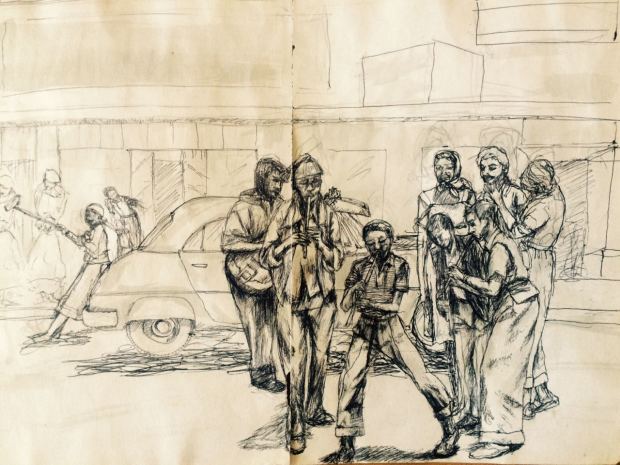
"The Pennywhistlers" by Sakhile Gumbi


The nickname 'Little Harlem' certainly evokes a sense for how lively Sophiatown must have been in its heyday - what similarities were there between the home of Lindy hop?
Yes, it must have been a very vibrant place. People dressed in a special way, spoke their own language created from the different influences of African Languages and Afrikaans, and there were different gangs called the Berliners or the Americans, dressed in funky clothes.

The most obvious link to Harlem was music. Sophiatown was very much influenced by jazz music from the US. Which in the end is music from Africa, so that is kind of a back and forth. And the atmosphere must have been similar, exuberantly showcasing a different kind of lifestyle.

Harlem's Savoy Ballroom was the home of Lindy hop that has now sadly passed into legend - where was Sophiatown's old epicentre and where is becoming the new hub?
Sophiatown´s epicentre was Good Street. That´s where its cinema The Odin stood, which served as a kind of public gathering space and it's something you could compare to the Savoy Ballroom.

There were illegal drinking spots and shebeens that brimmed with life as, at that time, it was illegal for African natives to drink and shebeens were the meeting places - more or less the living rooms of different people transformed into bars, and that’s where everything happened - where jazz musicians performed and people drank and danced and discussed social ills. The most famous shebeen was called '39 Steps' and was located on Good Street.

"Inside Shebeen" by Sakhile Gumbi


And can you tell me about the dancing? Was Lindy hop or jazz dancing popular before apartheid?
The Apartheid regime was officially introduced in 1947 but the racial discrimination had already started well before that. Dance and music had always been a form of protest in South Africa, and I guess that is very understandable as a dancer. Dance and music go beyond words. They deliver a message that can neither be read or heard but be very much felt and understood in the heart. 

Even before Apartheid, Sophiatown was already called Little Harlem, and people were already hooked on jazz music and its blend, or should I say its re-blend, with African music and its dances.

Frankie Manning went to see Sophiatown sometime around 2004 but we couldn´t find out any more about it. It still seems that he also wanted to discover the link to the big Harlem in the US.

What about now - I've read a little about the fusion of swing and jazz with African dances, what are pantsula, township jive and marabi like and what are their origins? Do you have any videos to share?
All origins of those dances are in Sophiatown: Township jive and marabi relate a lot to Jitterbug and swing dances from the US but they have their own African dance influenced elements to it. They are not practised any more in the sense of a social dance community but you can see them on stages where people try to reconstruct them from the rare footage that is left of them. We could only find a few people that actually still remember some moves but the footage is mostly lost.

Pantsula is also rooted in jazz dance moves but kept on evolving until now and is still very much practised in South Africa. You can find some videos online but they are not original footage, rather, they are adaptations of what it used to look like. Unlike in the USA, in Africa at that time the same techniques and technology were not widely available to the African people so less footage was taken and most of it has been lost.


Dancing is impossible without good music - is there a Sophiatown 'sound' and who were/are the most iconic past and present artists and bands who provided it?
There definitely is such a sound. It´s very unique music and has recently been getting more attention. It´s mostly called Kwela and it has a very intriguing sound where you just can't stop tapping your feet! Back in the day, the most famous musicians were Miriam Makeba, Hugh Masekela, Dolly Rathebe, The Manhattan Brothers, Todd Matshikiza, Kippie Moeketsi, and Dollar Brand amongst others and today´s artists are reconnecting with that music.

Tell me a bit more about the festival itself - what else is it celebrating? Other art forms, famous former and current residents, food?
The festival is meant to celebrate Sophiatown´s cultural heritage as a whole, meaning its music, dance, literature, fashion, photography and atmosphere, and we want to bring the celebration to the place where it all started: the streets of Sophiatown. Today theses streets are mostly inhabited by white settlers but you can still fell the vibe when you walk around. It's still a very special place.

On the day of the festival, people will be able to experience Sophiatown through the arts that once made it famous. There will be dance workshops where people can learn some Township dance move and there will be literature readings that will give people an insight into what life used to be like. There will be a guided tour through the Sophiatown of today by Mbali Zwane, who was one of the first people to teach about Sophiatown´s cultural heritage and she will take visitors to the places that once played such an important role in Sophiatown, like the place where the Odin stood or where famous shebeens were standing. Her tours are very much alive and full of theatre and singing performances.

We will serve authentic food and the day will end with a big concert featuring famous South African jazz artists showcasing the music of bygone days with photos in the background illustrating how things were. Aaaaand hopefully people will feel inspired enough by their experiences that they will practise the moves they will have just learnt!

And perhaps most importantly, can anyone help make this happen?
Sure, we still have our crowdfunding campaign on Indiegogo going on, where people can support us in any way that they can - either by making a donation or by purchasing 'perks' such as art prints, bags or CDs from McCoy Mrubata - and all of these contribute directly to our campaign.

Filming the crowdfunding video: Mtsembeni chatting to McCoy Mrubata, who is sat beside the statue of Sophiatown legend Kippie Moetketsi
Even if people could share and like our Facebook page it would help us get greater recognition and if they know anyone who is funding these kind of projects please help us get in touch! We feel that Sophiatown holds so much cultural heritage that we think it is more than worthy of getting the title of cultural world heritage by UNESCO. So if anybody has contacts leading there please let us know!

We also hope to get attention for the dances and also for Lindy hop. Murial and Brendan from Cape Town are trying to build a Lindy hop scene in Johannesburg but as yet, even in Africa, most of the dancers are white so we hope to attract more people of different backgrounds with the powerful interracial history of Sophiatown.

We want to celebrate the life and legacy that Sophiatown and its people left for us: to keep the spirit of Sophiatown alive for generations and generations to come; to discover and acknowledge.

Mayibuye iSophiatown!


Kristina with Vuyiswa Ntombela from Fruitcake Vintage and Eugene Maliboho.

I'm extremely grateful that Kristina not only got in touch to tell me about this amazing project but also that she took the time to share so much about its backstory and future direction. I shall be paying close attention to the resurgence of Little Harlem! Best of luck!

Thursday, 8 June 2017

speaking swing with an accent

I refuse to apologise for puns.
As Belfast continues to blossom, and more and more new people come to classes and socials each month, it's always worthwhile asking a newbie for a dance or two.

For me, having a chat after (or during!) a dance is also largely unavoidable, and one of the things I usually end up asking is whether these newfound recruits have done any dancing before, often with my inquisitiveness driven by how rapidly the new dancers seem to pick things up.

Whether they are entirely new to dancing or have come from another style makes their nascent prowess no less impressive, but in the case of the latter, there are usually little giveaways as to their dancing background.

Salsa dancers have their hip sway, ballroom dancers are upright, ballet dancers are always on their toes, Irish dancers are upright and on their toes and have their arms straightened by their sides, and street/breakdancers have exaggerated rock-steps.

And I am sure that there must nuances of other dance styles that would seep into how someone swing dances (I don't know how to recognise them yet!) but nearly every time I ask if my hunch is correct it is misinterpreted as criticism. That couldn't be further from the truth.

I think of it in the same manner as having a chat with someone whose accent suggests they aren't speaking in their mother tongue - it's out of a genuine fascination that I'm curious to hear where they grew up, rather than any form of antipathy. And just as a slightly different cadence in someone's speech adds a little extra colour to their words, the unique colourful timbre of an individual's dancing adds to the myriad hues of a dancefloor.

In fact, speaking with an 'exotic' inflection doesn't even have to mean having origins in a different country - Northern Ireland has enough heterogeneity in its accents that you can tell when someone is from further than 20 miles away; and then it's considered polite to express amazement at how far they've travelled.

On top of that, accents not only reflect a dancer's background but can also reflect the background and culture of an entire community, country or continent, and the more I travel or watch videos online the more I start to recognise different aesthetics within our global swing family.

As a related historical note, two flavours of Lindy hop were considered to have developed in the USA in the late 1930s and early 1940s and were labelled as 'Savoy'-style and 'Hollywood'-style, as per their origins.

'Savoy'-style was so named for the Savoy Ballroom - the vaunted Harlem home of 'Shorty' George Snowden, Frankie Manning, Norma Miller and others, whilst 'Hollywood'-style became synonymous with Dean Collins: an erstwhile Savoy dancer who left New York in 1936 for the silver screens of Southern California and took his own brand of Lindy hop with him. (And depending on who you talk to, Collins is also considered the progenitor of west coast swing.)

The perceived differences between 'Savoy' and 'Hollywood'-style (and why the use of such labels has been abandoned by contemporary Lindy hop) have been thoroughly considered in an excellent article by Bobby White, but whilst these particular labels no longer hold water, I do not think I'm alone in recognising nuanced differences in the vernacular of current European, Asian and American dancers with regards to technique, styling and even demeanour.

What I', trying to emphasise, and especially to the new dancers, is that none of these differences has more merit than another: variety exists, and the global swing dancing community is all the healthier for it. So whether it's between or within scenes, on an international level or on an individual one, in all circumstances these differences celebrate the motley provenance of what is your own style.

We all speak the same swing language, we just do so with different accents.

Saturday, 4 February 2017

Mother City Hop 2017: South Africa's Swingin'

Is the rest of this article even needed? Look. At. That. View!


[NB - this interview is from 2017]

As I proudly shared in my most recent article, the swing scene in my home city of Belfast, Northern Ireland is now growing apace, but there are of course myriad other scenes across the world with different stories yet similar trajectories and it is exhilarating to hear about them and what they're bringing to their respective cities.

Without question, one of the most exciting up-and-coming scenes is that of Cape Town, South Africa, which is one of only two Lindy hop communities on an entire continent and last year [2016] they hosted Africa's inaugural international Lindy hop event: Mother City Hop.

Through my Frankie Manning Foundation scholarship in 2015 I was fortunate to meet a couple at the vanguard of the (South) African Lindy hop community - Muriel and Brendan Argent - and I was able to hear the plans and enthusiasm they had for their swing scene in Cape Town.

Last year [2016] these plans came to fruition and Mother City Hop was by all accounts a massive success, so with MCH 2017 just a few months away, I got the opportunity to chat to Brendan and to learn a little more about how things all came together last year whilst also getting a preview of what's yet to come.


Brendan, from what I've heard, Mother City Hop went really well last year and yet it was your first ever event! How did you manage to pull it off?!
It really was a wonderful event and we got a lot of positive feedback, which was gratifying after the hard work! I think the international Lindy hop community was keen to support it, because it was the first big festival on the continent and we had contributors to the crowd-funding campaign from all over the world.

Having a really solid and enthusiastic team was key to it all working out. We also spent a lot of time speaking to experienced organisers from other events, so even though it was a first for us, we were able to learn from their combined experience. And then the teachers also deserve a really big thank you, they were there to step into gaps and help out when things got a bit chaotic.

Obviously a thriving local scene is a necessary bedrock for hosting a large event but I read, incredibly, that Cape Town Swing has only existed since 2015! How'd it all begin and how big are you now?
The first swing classes in Cape Town started in late-2011 thanks to Jeannie Elliott. A small group who had been learning from YouTube discovered that she had moved to Cape Town from Texas, where she had been teaching Lindy hop for 10 years. She started Boogie Back Dance Co. (a Lindy hop school) soon after that, and the dancers who were learning from her formed the Cape Underground Swing Syndicate to coordinate social dance opportunities. By the time Muriel and I started dancing in 2013, that group had largely moved on to other things and so we and a few others took over and rebranded as Cape Town Swing at the start of 2015.

At the beginning we could maybe draw 30 dancers to a party, but by Mother City Hop 2016 we had 85 dancers register from South Africa, which was basically every Lindy hopper in the country. In total we had 168 dancers at the festival, so about 50% were from overseas (representing 17 different countries). In the last year, in part due to the exposure from the festival, we have grown steadily and hope to have over 130 locals at the festival.

a class in full flow in one of MCH's beautiful venues: Youngblood Africa
I noticed a brilliant scholarship scheme on your website - how long has this been running and how do you raise money for it? Can anyone make donations?
We started the program in late 2015, and managed to award scholarships to five talented and enthusiastic dancers in Cape Town prior to the festival. They were each given free classes and their transport to and from home was covered.

For the funds, we basically set aside a percentage of our revenue from parties, but we also opened a “Pay It Forward” option on the Mother City Hop ticket sales last year, which helped a lot. It’s a really important program that we hope will help grow the Lindy hop scene beyond the city centre and the limited demographic in a very segregated city. If anyone would like to donate, they can do so here: mothercityhop.com/pay-it-forward

I hope you can continue that great work! I also remember from last year that you linked up with
Mozambique's swing scene - is something similar happening this year?
Yes, there is a growing swing community in Maputo and they are having an exchange in the week before Mother City Hop. Last year it was amazing, they are so welcoming and though the community has very little in terms of resources they are incredible dancers and it's a very special exchange. Check out a video of last year's MASX (Maputo Afro Swing eXchange) here.

It is really cool to hear that Africa's two nascent scenes are so supportive of each other! For this year's MCH I see that once again you've a fab teacher line up but what can you tell me about the bands?
Finding swing bands has been a huge challenge for us. One thing our scene really lacks is good live music for dancing. Both of the bands that played last year no longer exist, and although there is a big jazz culture in Cape Town, it’s not very dancer friendly and we've struggled to get bop-heavy musicians to see the value in good old-school swinging jazz!

[...that sounds a lot like Frankie's struggles in the 1940s!]

We have a Big Band project that is very exciting, with a group that has just started working on some classic big band charts. If anyone is able to support this project and help us cover the costs of the music, venues and transport (many of the musicians live quite far from the city centre) that would be much appreciated but we're hoping to have a set ready in time for the festival!

Ryan Calloway leads the Hot Baked Goods in San Francisco, and he will be working with a smaller group of local musicians in Cape Town prior to Mother City Hop, so they will play one of the nights. We do have a growing DJ group that has been keeping our dance floors jamming. This is led by Lise-Mari aka DJ 20th Century Fox, who DJs primarily from vinyl. We’ve also been discovering some really great South African swing that was played in the townships during apartheid (particularly Sophiatown, which was known as "Little Harlem"), like this track by the Manhattan Brothers.

I'm sure dancing to some local swing music will be a brilliantly unique experience! Your workshop & social venues look incredible - can you tell me a bit more about them?
Venues are always a challenge! As in many cities, there is a constant battle to keep live music venues open. There are sadly very few venues where music can be played after 11pm. We have however found some really stunning venues for our parties.

Oudekraal, the venue for our welcome party is a private beach just behind Table Mountain. We'll go there for sundowners and then dance under the stars on a specially prepared dance floor! Our main feature party is at a stunning ballroom at the Italian Club of Cape Town, which has a beautiful sprung wooden floor. We're going to keep our other two venues a mystery for now, as we'll be doing a big reveal soon!

another brilliant workshop venue, with Remy Kouakou Kouame showing the way

As well as the obvious dancing and warm greeting, what else should people expect from Cape Town and the tours you've put on?
Cape Town has something for everyone! Right under the mountain, there are hikes and trails just two minutes away and beaches in all directions, but besides its beautiful landscapes it also has a rich history and there are some very special museums and galleries worth exploring. Cape Town is famous for its diversity of culture, architecture and food and especially for its hospitality and we can't wait to welcome dancers to our city!

Something often left off the tourist brochure is the huge inequality in the city. Most of the city's population lives beyond the city centre in areas with fewer facilities, transport and opportunities. Due to the apartheid laws, people were forcibly moved to areas according to their skin colour, and sadly the city is still very segregated along these lines.

One of the stops on our tour package is a visit to one of the biggest townships. We don't support 'poverty tourism' and have been very careful in planning this so as to be sensitive about it, but we think that it’s important to see both sides of the city and it's also an opportunity to support some of the local businesses and cultural activities.

That's very admirable and I'm sure it'll be hugely informative for the hordes of visiting Lindy hoppers! I imagine most visitors may be coming from Europe/USA so getting to South Africa may initially appear more expensive, but how do daily expenses (accommodation, food, drink, public transport etc) compare to a European/US city?
There are some great flight specials on at the moment, so people might be surprised by what they can get away with in terms of airfares, but in terms of daily spending, a meal in Cape Town will range from R40-R90 and a beer from R20-35. Uber is very cheap and convenient with trips around the city centre from R20-R30 and longer trips like to/from the airport about R90-R120. There is also a fantastic new bus system (MyCiti) which works out even cheaper. March is busy in Cape Town and accommodation fills up fast, but prices for a night’s stay range from R450 (a nice backpackers) to R900 (guesthouse) to R1500 (hotel). Dancers can also apply to be hosted by local dancers.

[TheSwingSlate has conveniently averaged and exchanged those prices into GBP, EUR and USD:

     meal:  £3.90  /  4.60€  /  $4.90
     beer:  £1.65  /  1.85€  /  $2.05
     taxi:  £1.50  /  1.75€  /  $1.90
     hostel:  £27  /  32€  /  $34
     guesthouse:  £54  /  63€  /  $68
     hotel:  £90  /  105€  /  $113

That's a lot more affordable than the major European or American cities that travelling Lindy hoppers visit! Over a few days it may well offset the higher flight prices!

In case anyone inexplicably needs further convincing, do you have any videos from MCH 2016 or to showcase what a gem of a scene you've got?
Yes! We have an iCharleston video from 2015, some great photos from last year's MCH here, and below is the event highlights reel!


And finally, for any other growing scenes, what tips do you have to turn things into such a success in such a short space of time?
Outdoor dancing is the best way to draw people in. People love the music and can see how much fun the dancers are having, it’s infectious! This is definitely the number one piece of advice I would give.

...that may be brave in Northern Ireland but I suppose it did Gene Kelly no harm!

Apart from that, things that help: broaden the net. Target older folk and younger folk. Teach kids in schools and then teach their parents. Universities are also a great place to draw the student crowd. Get a strong team together so that no one person carries all the work. This is another way to keep people involved, as it makes them feel part of something. There can be a role for everyone.

Someone to coordinate DJing, someone to inspire the scene with the history, someone in charge of welcoming new dancers, someone in charge of scene safety etc. Link up with local musicians if you can. But Lindy hop speaks for itself and if people see you having a good time on the dance floor they will want to learn too :)

Brendan & Muriel casually getting in some practice on a local saunter.


A big thanks to Brendan for taking the time to answer my questions, and he tells me there are still a few tickets left so if anyone wants to visit the one of the world's freshest and most colourful swing scenes, visit the Mother City Hop website and get booking!