Showing posts with label video. Show all posts

Wednesday, 16 August 2017

Sophiatown: the revival of South Africa's 'Little Harlem'

Sophiatown's history is steeped in jazz music and dance

Earlier this year I spoke with Brendan Argent, one of the flag-bearers for Cape Town Swing and Mother City Hop, on the growth of their local swing community and its establishment as a global Lindy hop destination.

It's incredibly encouraging to hear about the success stories of nascent scenes, and especially in Africa where the rhythm roots of Lindy hop and jazz run deepest. But another South African community that is undergoing a swing revival is that of Sophiatown: a Johannesburg suburb that was once the nation's beating cultural heart. 

To get a feel for Sophiatown's former glory you need only discover its former nickname of 'Little Harlem', but its proudly held reputation for multiculturalism also attracted the attention of the apartheid regime which set about Sophiatown's systematic destruction in the early 1950s.

Off the back of my article with Brendan I was contacted by Kristina Kreul who, along with Mtsembeni Masina, is championing Sophiatown's jazz renaissance and is understandably keen to raise the profile of the project they hold dear.

left to right: Mtsembeni Masina, Kristna Kreul and Sakhile Gumbi


Kristina, I understand you're not from Sophiatown, or even from South Africa - how did you come to be involved?
I'm from Germany (currently living in Berlin) and originally I went to Swaziland with a friend from Sweden, Mia Bergdahl, to help build an amphitheatre for a rural community. Sadly, that project didn't get off the ground for a few reasons so we decided to leave Swaziland and travel around South Africa. As I like travelling and discovering different dances I wanted to find out a bit more about pantsula - a dance from South African townships that I'd seen featured in a short TV documentary. The documentary connected pantsula with the Jitterbug dances of Harlem, New York and as a Lindy hopper that really caught my attention.


How did you meet Mtsembeni and what is his connection to Sophiatown?
On my penultimate evening in Swaziland I went to a show where Swati artists were showcasing their music and poetry - so much talent there! And that´s where I met Mtsembeni - he was from Johannesburg and we soon started talking about jazz music and dance. I'd just visited Herräng for the first time in the summer of 2016 and I told him about Herräng and the history of Lindy hop, and then asked Mtsembeni if he knew anything about pantsula - as it happened he was just the right person.

He loves jazz, studied jazz music for a while himself and is deeply into South African jazz music, and on top of that he had worked as a tour guide in Johannesburg so he offered to show me around Johannesburg if I ever visited. And one week later I did just that so I got to see pantsula first hand and learned that it was born in Sophiatown.

I also got to start learning the dance itself and I have Eugene Maliboho to thank for that! He taught me pantsula and is associated with Move into Dance Mophatong in Johannesburg, whose contacts have been really helpful in getting this campaign going!

I was intrigued about this place that had been called Little Harlem due to the obvious reference to the Harlem that holds such a dear place in the hearts of the swing community and shares a similar history. And just as in the Savoy ballroom, in Sophiatown people of different skin colours would dance together, discuss politics and enjoy music. But as the Apartheid was on the rise the South African government levelled Sophiatown to the ground in 1955 as they pushed forward their racial segregation.

Mtsembeni leant me a lot of books, music, photographs and so much more to get a better understanding of this place. Soon I realised that, with its destruction, most of Sophiatown's culture had gone, and the dances that formerly had a home there no longer had a home anywhere anymore, and I then immediately thought of Lindy hop and its comeback in the 1980s after being forgotten for decades.

And though the reasons are very different I thought, well, if Lindy hop could make a comeback, why should that not be possible for the dances and culture of Sophiatown?

What do you most love about Sophiatown's past and present and what do you see for its future?
Its past is just so full of art and political energy, and there was insanely good music and dance. Hugh Masekela, South Africa´s most famous trumpet player got his first trumpet from Louis Armstrong! Trevor Huddleston, a priest in Sophiatown, recognised Masekela´s talent and wrote to Louis Armstrong and he was sent a trumpet in return! And Miriam Makeba, an icon of South African music, also started her career here. 

There was fashion, a special way to dress, that is slowly returning now. There was literature, photography and so much more - all of great importance to today's South African identity. And it was also a very political environment. Nelson Mandela held his first memorable speech there, and it was where people would meet and discuss how to overcome the racial discrimination.

I think I am still very much intrigued by how music and dance were used as a form of protest, as an expression of injustice.
  
Who else has been involved besides yourself and Mstembeni?
My friend Mia Bergdahl helped us with the development of the project as she is very experienced in cultural development. Sadly she had to leave the project though.

Sakhile Gumbi, a visual artist and dear friend of Mtsembeni, helped out with the graphic design and designed prints that are some of the 'perks' available to those who contribute to our crowdfunding campaign, and as part of our crowdfunding promotional video we were able to get a few big names on board to help us!

McCoy Mrubata is a multi award winning composer and saxophonist who has attained national legend status, and Sibusiso Lerole, 'Big Voice Jack Junior', continues to play the same penny whistle that his dad 'Big Voice Jack'  famously played back in the day in Sophiatown and across the world - both are internationally renown South African musicians who have celebrated their connection to Sophiatown and both have featured in our video!
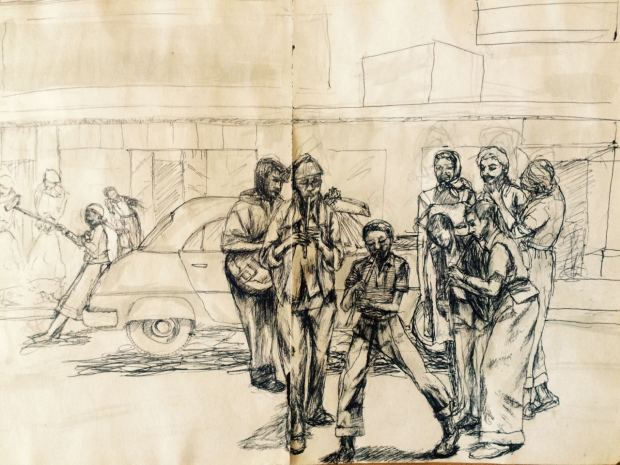
"The Pennywhistlers" by Sakhile Gumbi


The nickname 'Little Harlem' certainly evokes a sense for how lively Sophiatown must have been in its heyday - what similarities were there between the home of Lindy hop?
Yes, it must have been a very vibrant place. People dressed in a special way, spoke their own language created from the different influences of African Languages and Afrikaans, and there were different gangs called the Berliners or the Americans, dressed in funky clothes.

The most obvious link to Harlem was music. Sophiatown was very much influenced by jazz music from the US. Which in the end is music from Africa, so that is kind of a back and forth. And the atmosphere must have been similar, exuberantly showcasing a different kind of lifestyle.

Harlem's Savoy Ballroom was the home of Lindy hop that has now sadly passed into legend - where was Sophiatown's old epicentre and where is becoming the new hub?
Sophiatown´s epicentre was Good Street. That´s where its cinema The Odin stood, which served as a kind of public gathering space and it's something you could compare to the Savoy Ballroom.

There were illegal drinking spots and shebeens that brimmed with life as, at that time, it was illegal for African natives to drink and shebeens were the meeting places - more or less the living rooms of different people transformed into bars, and that’s where everything happened - where jazz musicians performed and people drank and danced and discussed social ills. The most famous shebeen was called '39 Steps' and was located on Good Street.

"Inside Shebeen" by Sakhile Gumbi


And can you tell me about the dancing? Was Lindy hop or jazz dancing popular before apartheid?
The Apartheid regime was officially introduced in 1947 but the racial discrimination had already started well before that. Dance and music had always been a form of protest in South Africa, and I guess that is very understandable as a dancer. Dance and music go beyond words. They deliver a message that can neither be read or heard but be very much felt and understood in the heart. 

Even before Apartheid, Sophiatown was already called Little Harlem, and people were already hooked on jazz music and its blend, or should I say its re-blend, with African music and its dances.

Frankie Manning went to see Sophiatown sometime around 2004 but we couldn´t find out any more about it. It still seems that he also wanted to discover the link to the big Harlem in the US.

What about now - I've read a little about the fusion of swing and jazz with African dances, what are pantsula, township jive and marabi like and what are their origins? Do you have any videos to share?
All origins of those dances are in Sophiatown: Township jive and marabi relate a lot to Jitterbug and swing dances from the US but they have their own African dance influenced elements to it. They are not practised any more in the sense of a social dance community but you can see them on stages where people try to reconstruct them from the rare footage that is left of them. We could only find a few people that actually still remember some moves but the footage is mostly lost.

Pantsula is also rooted in jazz dance moves but kept on evolving until now and is still very much practised in South Africa. You can find some videos online but they are not original footage, rather, they are adaptations of what it used to look like. Unlike in the USA, in Africa at that time the same techniques and technology were not widely available to the African people so less footage was taken and most of it has been lost.


Dancing is impossible without good music - is there a Sophiatown 'sound' and who were/are the most iconic past and present artists and bands who provided it?
There definitely is such a sound. It´s very unique music and has recently been getting more attention. It´s mostly called Kwela and it has a very intriguing sound where you just can't stop tapping your feet! Back in the day, the most famous musicians were Miriam Makeba, Hugh Masekela, Dolly Rathebe, The Manhattan Brothers, Todd Matshikiza, Kippie Moeketsi, and Dollar Brand amongst others and today´s artists are reconnecting with that music.

Tell me a bit more about the festival itself - what else is it celebrating? Other art forms, famous former and current residents, food?
The festival is meant to celebrate Sophiatown´s cultural heritage as a whole, meaning its music, dance, literature, fashion, photography and atmosphere, and we want to bring the celebration to the place where it all started: the streets of Sophiatown. Today theses streets are mostly inhabited by white settlers but you can still fell the vibe when you walk around. It's still a very special place.

On the day of the festival, people will be able to experience Sophiatown through the arts that once made it famous. There will be dance workshops where people can learn some Township dance move and there will be literature readings that will give people an insight into what life used to be like. There will be a guided tour through the Sophiatown of today by Mbali Zwane, who was one of the first people to teach about Sophiatown´s cultural heritage and she will take visitors to the places that once played such an important role in Sophiatown, like the place where the Odin stood or where famous shebeens were standing. Her tours are very much alive and full of theatre and singing performances.

We will serve authentic food and the day will end with a big concert featuring famous South African jazz artists showcasing the music of bygone days with photos in the background illustrating how things were. Aaaaand hopefully people will feel inspired enough by their experiences that they will practise the moves they will have just learnt!

And perhaps most importantly, can anyone help make this happen?
Sure, we still have our crowdfunding campaign on Indiegogo going on, where people can support us in any way that they can - either by making a donation or by purchasing 'perks' such as art prints, bags or CDs from McCoy Mrubata - and all of these contribute directly to our campaign.

Filming the crowdfunding video: Mtsembeni chatting to McCoy Mrubata, who is sat beside the statue of Sophiatown legend Kippie Moetketsi
Even if people could share and like our Facebook page it would help us get greater recognition and if they know anyone who is funding these kind of projects please help us get in touch! We feel that Sophiatown holds so much cultural heritage that we think it is more than worthy of getting the title of cultural world heritage by UNESCO. So if anybody has contacts leading there please let us know!

We also hope to get attention for the dances and also for Lindy hop. Murial and Brendan from Cape Town are trying to build a Lindy hop scene in Johannesburg but as yet, even in Africa, most of the dancers are white so we hope to attract more people of different backgrounds with the powerful interracial history of Sophiatown.

We want to celebrate the life and legacy that Sophiatown and its people left for us: to keep the spirit of Sophiatown alive for generations and generations to come; to discover and acknowledge.

Mayibuye iSophiatown!


Kristina with Vuyiswa Ntombela from Fruitcake Vintage and Eugene Maliboho.

I'm extremely grateful that Kristina not only got in touch to tell me about this amazing project but also that she took the time to share so much about its backstory and future direction. I shall be paying close attention to the resurgence of Little Harlem! Best of luck!

Monday, 23 November 2015

Uptown Funk in Hollywood's Golden Age


There are loads of new-tune-on-old-footage videos kicking around but I think this is the first with proper editing! The video's matched to the tune and the footwork's matched to the rhythm so the dancers hit the darn breaks!! It's incredible!!

Gene Kelly, Donald O'Connor, Fred Astaire, Ginger Rogers, the Nicholas Brothers, Judy Garland, Eleanor Powell, Jane Powell, Dick Powell, Rita Hayworth, James Cagney, Ruby Keeler, Laurel and Hardy, the Marx Brothers... so many incredible titans from the Golden Age of Hollywood, and make sure to switch on the subtitles to see the names of the featured films! Enjoy!

Friday, 11 September 2015

Swingin' in the street with Improv Everywhere


Improv Everywhere describe themselves as a "New York-based prank collective that causes scenes of chaos and joy in public places" and I'm entitled to very much agree!

Their activities are not just limited to NY as they often coordinate larger nationwide and international capers (one of which, "No Pants Day" I participated in when I lived in the San Francisco Bay Area) but this is one of my favourites so far.

It features pedestrians at an street crossing who 'spontaneously' partner up and start dancing in the middle of the junction, causing much mirth and it even kicks off with a li'l bit of Lindy!!

Wednesday, 17 June 2015

Video: Ben & Virginie @ Swingsation 2015


I've got into the habit of posting wee things on my Facebook page but not actually on this blog so this is the start of me addressing that!

And as it is Wednesday (henceforth referred to as WESTnesday... see what I did there?!) I'm sharing a video from an annual west coast swing event in Australia called Swingsation.

The default video I go to when showing people what WCS can look like at its finest is from last year's Swingsation event and features my favourite couple: Maxence Martin & Virginie Grondin. This year, it has has produced another incredible bit of lead and follow action, again featuring Virginie Grondin but this time being led by Ben Morris.

Enjoy.

Monday, 9 February 2015

Budafest 2015

my new benchmark for swing weekenders


Having finally made it to Budapest after my Canadian Capers and 60 hours of travelling through six airports and a choice selection of planes, trains and automobiles I was over the moon to see the Budafest sign being waved at me by a representative from NurShuttles*, knowing that I could now relax without thinking about logistics for at least another 4 days. (*as well as coordinating the transport of several hundred people, Nur also has an ace swing meme tumblr worth checking out: Get Off My Slot)

And after spending the previous few nights either in transit or couchsurfing, I can tell you that arriving at a 5* hotel, slap bang on the Danube River and with the iconic Buda Castle and Széchenyi Chain Bridge visible from our bedroom window, was a truly wonderful feeling. And from there it only got better.

Anna met me in the foyer and as she and Richard had arrived and checked in a day earlier I was taken straight up to the room I was sharing with them and Sharon (who was to arrive later that night).

I didn't really have time to unpack or rest as the first workshop of the weekend was to begin in an hour and we all still needed to eat. In fact, that was to become a perpetual dilemma throughout the weekend: having to choose whether to dance, eat or sleep with only time enough for one. Thankfully I'd spent a few days in Budapest a few years previously because I saw nothing of the incredibly beautiful city on this occasion, aside from three restaurants and a supermarket.

I imagine most folk reading this are of a lindy hop persuasion so allow me to quickly explain how lindy hop weekends differ from west coast swing weekends.

To begin with, and based only on my experiences so far, lindy hop weekenders tend to spread you across a city whilst the WCS equivalents are usually in one place. Workshops here, socials there, competitions somewhere else, and accommodation in another location altogether is the norm for lindy hop. That's not a fault, and there is definitely a charm in getting the opportunity to see a bit of the city.

But by contrast, the workshops, competitions, social dancing and accommodation for west coast swing weekenders are all in one big hotel, which is not only incredibly convenient and time efficient (walking from your room to class/socials in dance shoes and without a jacket is a simple pleasure) but also a lot more sociable as having everyone concentrated in one building makes it much easier to meet and get chatting to other folk there.

Another difference is the time spent dancing. No one can argue that lindy hop is not a heck of a lot more energetic than west coast swing - more recovery time is definitely needed and so more recovery time is usually scheduled - but the upshot of this is that at west coast swing weekends the party don't stop! Workshops start between 10am and noon, and aside from a few brief breaks there is no let-up in the dancing until breakfast at 7 or 8am the following morning. So it is not unusual to be on your feet for the best part of twenty hours straight.

Why these events don't have sponsorship deals with Red Bull or ProPlus is beyond me.

One of the first engagements of WCS weekends are the auditions for workshops to make sure you're in a level of class that matches your ability - not only for your own benefit but also to ensure that the class as a whole are roughly on the same page - and, for me, the audition provided one of the highlights of my weekend.

For Budafest there were four workshop levels and '5' was top (there were no level 1/beginners). Having already seen some of the dancing on display I was a little intimidated so, coupled with a few pre-existing doubts, I figured I was somewhere between levels 2 and 3. I decided to push myself and audition for level 3 anyway hoping that the embarrassing story we'd all just heard prior to auditions (of a girl being dropped 2 levels) would not have a sequel starring yours truly as the new flop.

Having adorned ourselves with coloured stickers corresponding to the level we were auditioning for we had to partner up with a lead/follow nearest us for two songs whilst the weekend's organisers and pros looked on. Come the end of the second song and thinking I had survived the cull I spotted my west coast swing hero, Maxence Martin (think Skye Humphries with a French accent and a black belt in judo), walking past everyone else and towards me with purpose.

"You should try out for this level." And then he handed me a different coloured sticker and sauntered off.

In that instant I hadn't a clue what this new colour meant but, coupled with my doubts and the crushing feeling I'd just been demoted by Maxence of all people (we all have dancers we want to emulate but I'm just not cool enough to pretend I don't!), I accepted the sticker with aloof nonchalance in a bid to hide my disappointment, then calmly walked off the floor before I was hit with the realisation that I'd actually been promoted to level 4! And with that my 'coolness' made a swift exit.

I still had to audition for my new level and thankfully got through it without anyone deciding that Maxence had just had a rush of blood to the head and I should go back to where I belonged. Whether my promotion just had something to do with needing to balance leads/follows I don't know but I'm taking it as positive nonetheless!

The workshops themselves were just phenomenal and as well as great individual classes by Lee Easton & Fabienne Henshall, Michael Kielbasa & Catriona Wiles, Chuck Brown, Ben Morris & Jennifer DeLuca, and Maxime Zzaoui & Virginie Massart my group also had the bonus of two classes from Maxence Martin & Virgine Grondin, hands down my favourite dance pairing, and Jordan Frisbee & Tatiana Mollmann, arguably the greatest partnership ever to have danced west coast swing.

One of the 'quirks' of the first few days of the weekend was the dancefloor (several tonnes of brand new wood-floor panels from Ikea). It was a great dancefloor - smooth, good speed (the slide/stability balance was just riiiight) but the static off it was something else! As it was broken in over the weekend the problem disappeared entirely but for the first day or two any time you held out your hands to a new partner the connection was quite literally electric and this was a particular problem for me and one other unfortunate guy on the Friday night at one of the big workshops where the class took up the entire ballroom.

clockwise from top: the view from our room, not bad, eh?; minor fanboy moment with my two favourite dancers, Maxence & Virginie; Anna and I ready for our first ever WCS competition


The rotation of partners in a dance class is nothing new and, as I said in one of my earliest posts, is a very important part of the learning process but for whatever reason, the entire class was split into two separate and very long parallel lines (about 60m) rather than one big circle, so once a girl got to the end of either line she had to run the full length of the line to partner up with me or the guy at the head of the other one. That run then gave these girls an entire hall's breadth to build up considerable static which they then dutifully released with a shock, a spark and an audible crack (and occasionally a yelp from me) each time one took my hand.

In this workshop at least I developed a growing reluctance to take the hand of a new partner as the class wore on but for the rest of the weekend the opposite was the case and I just could not get enough dances.

With somewhere north of 950 people in attendance (making it, according to the veteran west coast swing pro Chuck Brown, the biggest WCS event ever staged) I was as ever hopeful I'd have a few dance crushes but it went further than that and I experienced the best dances of my life as the connection I had with some of my partners blew my mind.

For anyone that hasn't read my article and doesn't know what a dance crush is, I'm not talking aesthetics or desires just (near) perfect connection for one or more dances with a complete stranger; but for one dance in particular in Budafest I can't describe it in any other word than 'beautiful'.

I don't know what that dance looked like to the casual observer and knowing my own ability level I am pretty sure most of the other couples dancing around us were much easier on the eye but I don't care - to me, it just felt phenomenal in the same way that only a few, very rare songs can make you feel. It's hard to explain without sounding overly saccharine... and to restore the balance I'm off to shave with an axe and wrestle a bear... but it's my blog and I'll share what I want to.

And that is to take nothing away from the other dances - seriously, other than a few on the first night before I had warmed up and two of the three dances during my competition heat (I'm not sure I'll ever do that again: fun thing + nerves = no fun) I didn't have a bad dance all weekend - but this one dance knocked my socks off.

I also discovered a few regional/national differences in dance partners, not only in their style but also just in general banter, which is why I am already booked and heading to the Holy Land Open in Israel at the end of this month! I'd prefer not to paint with broad, nation-sized strokes but if the rest of the Israeli dance scene are anything like the crowd I met at Budafest - some of the most fun people I met all weekend and absolutely some of my favourite dancers - then HLO is going to be on another level!

One down-side to such large events with so many people is that names (and nationalities) are a lot harder to remember and it often gets to the stage where introductions aren't even offered so it's very possible that I could make similarly complimentary collective observations about other countries but in this instance I am very grateful for a chance meeting at the airport on my way home.

I spotted an Israel-based friend of mine, Dana, also waiting for her flight so I went over to say cheerio but then recognised she was one of a whole crowd of my favourite follows who were all together and bound for the same homeland. So it required little more encouragement from Dana for me to register for HLO and book my flights to Tel Aviv.

Back to Budafest, though, and as I've mentioned, and as one of the photos above shows, I tried my hand/feet at competing in WCS for the first time but I think that that may also be my last.

I am a competitive person, so the idea of going up against the kind of talent that was on display at Budafest and getting some sort of commendation is very appealing, as is the challenge of trying to improve enough for that to somehow be achievable, but I just can't relax. I'm not blaming nerves for how I fared - I didn't have any expectations and I just wasn't good enough (although a quick shout-out to Anna who was placed in our heat by several judges but just not enough to get through to the final) but if several hours of my weekend are going to be dominated by nerves I don't think I want to have that ruining my vibe, man!

One of the amazing things about the competitions was the age of some of the dancers and there were a handful of incredibly talented girls from France who couldn't have been any older than 15 years old! At age 15 I had yet to grow into my size 12 feet and as a short and skinny kid with big shoes I bore a passing resemblance to a golf club so it's possible I just wouldn't have had the coordinated finesse anyway, but I really don't want to downplay how impressive these girls were and it takes little imagination to think they will be the megastars of the future.

In fact, (and seamlessly mixing two themes from the last paragraph), a good few years ago I played a round of golf with a kid from the next town over from me that probably could have fitted into the golf bag he was carrying at the time - and he is now the world's #1 golfer, Rory McIlroy. So maybe one day I'll be able to say the same about a dance partner.

Finally, it needs to be said just how smoothly the whole weekend was run so hats off to the organisers, Ádám Balásy and Rita Jóri, for putting on a stunner of an event and raising the bar for what to expect for a dance weekender. I imagine the concept of coordinating and scheduling almost 1,000 dancers into workshops, competitions and socials would leave many rocking back and forth and muttering but this was a slick and punctual event throughout and I'm already very excited to head back again next year.

Tuesday, 14 October 2014

lindy hop, east coast swing, west coast swing: what's the difference?

USA: the ancestral home of lindy hop, east coast swing and west coast swing


As I've said, the main dance styles I love are lindy hop, east coast swing and west coast swing, but how do they compare to each other?

Of those three, lindy hop is the old grandfather from New York whilst east coast swing and west coast swing are the cousins from opposite sides of the USA that maybe get together at larger family gatherings but otherwise keep to themselves for the rest of the year. I will get into the swing family genealogy in more detail in a later post but for now I just want to explain what sets them apart in practice.

In an overly simplistic sense, the basic steps of east coast swing and west coast swing have a 6-beat count whilst lindy hop has an 8-beat count - although the more you get into it, those rules sort of fall apart but we shall proclaim them as gospel for now! Lindy hop is generally danced to big band jazz and music from the swing era, east coast swing emerged a bit later and so it is popularly danced to similar music to Lindy hop but with doo-wop and rock & roll added for good measure, whilst west coast swing is the incredibly versatile relative newcomer that can be danced to just about anything but mainly comes out to play to contemporary R&B, blues and pop music.

East coast swing is the simplest of the three and the best place to start for a complete beginner as the steps are a lot less complex and the dance is more flexible, in that it can be danced to a wider range of tempos without requiring a huge change in skill. As you can see in this video, east coast swing is primarily a ballroom dance.


Lindy hop is usually danced to the same style of music as east coast swing and the moves of these two styles are completely interchangeable (along with Charleston and others) but lindy hop is a definite step up in difficulty as the footwork is a tad more complex and involves the 'swing out' which is the fundamental 8-beat basic that the style is based on. It is a lot trickier to faster music and also incorporates the aerial moves or 'air steps' that have made it so iconic and here's a video of two of my favourite lindy hoppers: Skye Humphries & Frida Segerdahl.


Although west coast swing has its origins in lindy hop it is often categorised separately as it is the newest of the three and one of the more technical styles as many of the moves are led in a more subtle fashion. It is generally danced to music that favours slower, flowing movement and 'stretch' rather than the up-tempo bounce or 'pulse' that characterises lindy hop or east coast swing but west coast swing can be adapted to just about any music genre or tempo; as demonstrated here by one of my favourite west coast duos of Maxence Martin & Virginie Grondin.


In terms of asking me to pick a favourite it would be like asking someone to rank their favourite offspring - I could probably confess that there are certain favourable characteristics that one has that another doesn't - but I really do love them equally and would encourage people to try them all!